

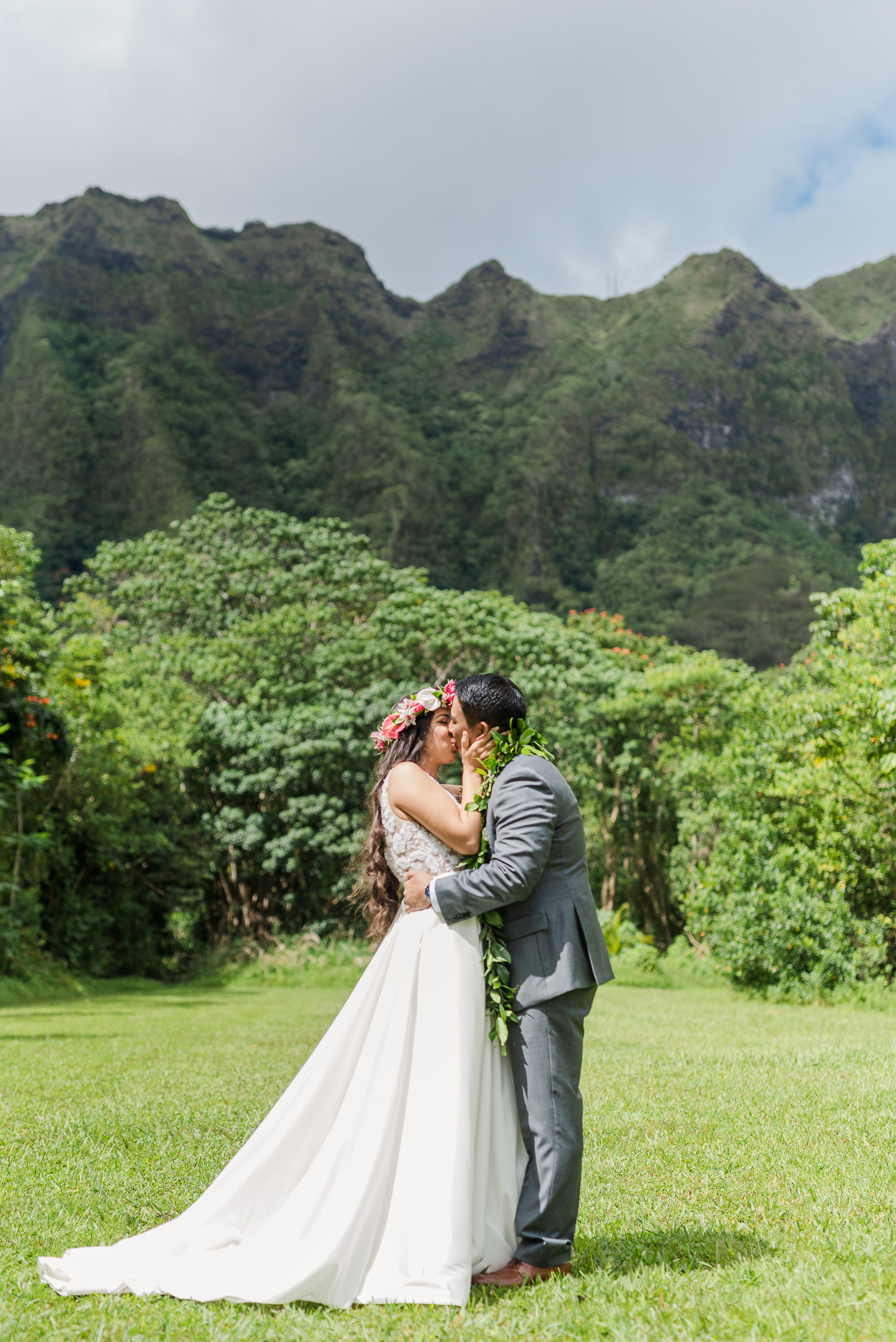
The Second Kiss: What It Is and Why I Do It at Every Wedding
Key Takeaways
- The second kiss happens during the recessional, not at the altar — most guests don’t see it coming
- It works because I walk backwards with the couple the entire length of the aisle, not from a fixed position at the end
- Couples rehearse it three times before the ceremony so when the pause comes, it’s instinct not confusion
- On long aisles, there’s room for a second and even third pause — each one a genuine, unposed moment
I’m Jonathan, lead photographer at Blessed Creatives. I’ve photographed weddings in Hawaii since 2014, and in that time one moment has quietly become the one couples tell me they didn’t expect to love as much as they do. I call it the second kiss at weddings — it happens during the recessional, about halfway down the aisle, and almost nobody in the room sees it coming — including the guests who are still cheering from the first one.
What is the second kiss at a wedding?
The second kiss is exactly what it sounds like. After the ceremony ends and the officiant announces you as a married couple, you share your first kiss at the altar. Then you turn and walk back down the aisle together. Somewhere along the way, before you reach the end, you stop and kiss again.
Most guests don’t expect it. Half the room is still applauding from the first one. There’s no announcement, no cue from the officiant. It just happens — and because nobody is bracing for it, the reactions you get are completely unfiltered.
That’s what makes the photos different from every other frame of the day.
How it actually happens
Some photographers walk to the end of the aisle and wait for the couple to come to them. I don’t do that.
By the time you take your first steps down the aisle, the officiant has already stepped aside. The aisle is yours. That’s the moment I start moving with you.
I walk backwards with you from the moment you leave the altar. My camera stays up. I’m moving at your pace, watching your faces, watching the guests in the background. And at some point during that walk, I stop.
When I stop, you stop. That pause is the cue. There’s no verbal instruction mid-recessional. No hand signal. My body stops moving and yours follows because we’ve already gone over this — you know what that pause means before we ever get to the ceremony.
That’s it. That’s the whole mechanism. The simplicity is what makes it work.
How we prepare for the second kiss
We cover the second kiss at the wedding three times before you ever walk down that aisle.
Once at the rehearsal. Once more at the end of the rehearsal. And once again right before the ceremony starts.
By the time the moment comes, it isn’t a surprise to you — it’s instinct. The guests don’t know it’s coming. Your family doesn’t know. But you do. And that confidence shows in the photos.
If you decide in the moment you’d rather keep walking, that’s fine. I keep moving too. No pressure, no awkward pause. But in over a decade of doing this, I haven’t had a couple who wished they’d skipped it.

Photo by Blessed Creatives
What couples actually do in the moment
Some couples keep it simple. A clean, natural kiss. Maybe a second longer than the first one at the altar.
Others surprise me — and sometimes surprise each other.
I photographed an outdoor wedding where the guests were standing and clapping after the first kiss, still caught up in the moment, when we paused mid-recessional. The couple went into a full dip kiss right in front of their guests. The cheers got louder. Men were fist pumping. People were yelling. It was the kind of reaction you can’t manufacture, and the image that came out of it is one of the strongest frames I’ve shot.
What made it work was that nobody posed for it. One partner had planned the dip. The other didn’t know it was coming. That split-second surprise on their face — that’s the photo.
Dips, spins, a laugh, a forehead press — whatever happens in that pause tends to be the most honest version of the couple I capture all day. The altar kiss has an audience watching for it. This one catches everyone off guard, including the guests.
What changes on a long aisle
A longer aisle isn’t a logistical problem for the second kiss at a wedding. It’s an opportunity.
I photographed a wedding in a church with about 40 pews on each side. That aisle gave us room for more than one pause — the kind of length where you can let the moment breathe, build, and happen more than once. Indoors, guests weren’t throwing anything, so the walk itself was the moment.
After the ceremony, we moved outside to the church steps. The guests came out with them, bubbles in hand, and the couple kissed again as everyone blew bubbles around them. Two distinct moments from one recessional, separated by a set of stairs and a crowd of people who had no idea we were still creating photos.
When guests are mid-activity during the recessional — bubbles, flower petals, rose petals — the timing gets more interesting and the images get more layered. That kind of coordination requires a conversation with your wedding coordinator ahead of time. If guests are lined up blowing bubbles as you walk past them, the pause lands differently than it does on an empty aisle. Both work. They just need different planning.
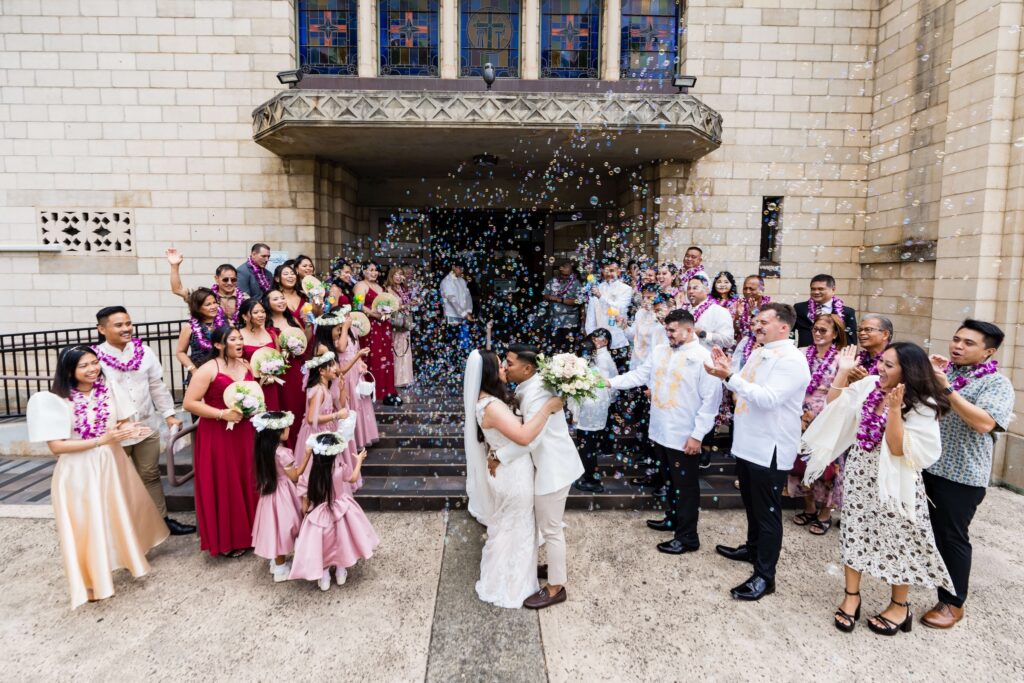
Photo by Blessed Creatives
Why these photos are different
The altar kiss is expected. Everyone in the room is watching for it, phones up, waiting. That collective attention is beautiful, but it also means the moment has a certain weight to it — people are performing their reaction as much as having it.
The second kiss at a wedding catches people mid-breath.
Half the room is still responding to the first kiss when it happens. Guests are looking at each other, laughing, wiping their eyes. When the couple stops and kisses again, the reactions you capture in the background are completely genuine. Nobody had time to compose themselves.
That’s the difference between a photo someone looks at and says “that’s a beautiful shot” and one they say “that’s exactly how it felt.”
One question to ask your photographer before you book
If this moment matters to you, ask your photographer one simple question during your consultation: do you walk backwards with us during the recessional, or do you position yourself at the end of the aisle?
The answer tells you everything. A photographer who waits at the end can’t create the pause. They’ll get a wide shot of you walking toward them, but they won’t be in a position to stop the moment — because they were never in it with you.
It’s not a trick question. Most photographers don’t do this, and that’s fine. But if a second kiss at your wedding is something you want, knowing the answer before you sign a contract matters.
Frequently asked questions
Does every photographer do this? No. It requires walking backwards with the couple the entire length of the aisle, which most photographers don’t do. If your photographer positions themselves at the end of the aisle and waits, the second kiss isn’t possible — there’s no one to create the pause.
Do we have to do the second kiss? Not at all. We go over it in rehearsal and before the ceremony, and if it doesn’t feel right in the moment, you keep walking and so do I. The goal is never to force a moment — it’s to create the conditions for one if you want it.
What if we forget in the moment? You won’t. That’s why we cover it three times before the ceremony. By the time you’re walking down that aisle, the pause is already part of how you’re thinking about that walk. And if for some reason it doesn’t land — that’s fine. There’s no version of this that goes wrong in a way that hurts the day.
What if we’re not big on PDA or we’re nervous about kissing in front of people? That’s more common than you’d think, and it doesn’t disqualify you from this moment. The second kiss tends to be easier than the altar kiss for exactly this reason — the pressure has already passed. The room is already cheering. Nobody is holding their breath waiting. A simple, natural kiss in that pause reads beautifully in photos even if it lasts less than two seconds. You don’t have to perform. You just have to stop.
Does this work on a short aisle? Yes. A shorter aisle means one clean pause, usually around the halfway point. It doesn’t need length to work — it needs the right timing, which is something I read in the moment based on where guests are, what they’re doing, and how the energy feels after the first kiss.
If you’re planning your wedding in Hawaii and want to talk through how we approach moments like this one, I’d love to hear about your day. Reach out through the contact form on the Blessed Creatives website and let’s connect.


